P: 1300 853 868 / 07 3056 0665
Mobile/Tablet Apps | Websites | Applications

Sunday, March 15, 2020

Positive Business during a COVID-19 Shutdown

Well - it's rapidly gotten weird and wild out there with businesses in every single sector of the economy poised to directly - and indirectly - cop a harsh beating from COVID-19 circulating around the Australian, and indeed global communities.

Government incentives, tax breaks, and handouts can help a bit to keep parts of the economy moving along, but what can you as a business do to help weather the storm and even come out the other side better than before ?

As Business Process and Technology Consultants we've recently been part of a number of internal conversations and discussions with our clients, many of whom are trying to war-game different scenarios around their business, industry, customer base, supply chains, and staffing.

Positive Business during a COVID-19 Shutdown (image credit:  pixabay.com)


The fact is that regardless of whatever disruptions might occur in the business community, there's always going to be an "after". Just like weathering a storm or bushfires, the crisis will eventually pass and that's the time to be ready to pick up the pieces and get moving with a renewed vigour!

Maybe you're in the same boat (let's face it, we are all actually in the same boat to some extent) ... so here are 6 of the ideas that we have been bouncing around, just in case they help:


1. Innoculate Your Cashflow


PROBLEM:  A small business in the service industry that relies on staff and/or customer attendance - such as a cafe, beautician, dentist, driving school - is going to suffer during any shut-down because there is literally no turnover/income during that time.

ANSWER:  Sell gift cards (online). Tell your story and get your local community behind you so that when you are able to trade again you still have staff and products to be able to get moving again.

CAUTION:  Remember that you must be able to eventually service the work for which you have been pre-paid and not just kick the ball down the road to become a bigger problem for another day.

_______________________________

2. Work Remotely

PROBLEM:  Your business relies on employees who can't come in to the office but don't have to be onsite for your business to continue operating (accounts personnel, software developers [like us!], sales staff, etc).

ANSWER:  Arrange for staff to work remotely if they need to be isolated for a period of time. Set up a Virtual Private Network (VPN) for staff to connect to the office network from home as if they were in the office. Make sure that your staff can work as "normally" as possible.

CAUTION:  Working from home isn't for everyone, and you have to help your staff stay focused - so regular video chats (using Skype, FaceTime, Google Hangouts, Zoom Meeting, GoToMeeting, etc) is great way to keep your team connected to each other.

Working from home isn't for everyone,
and you have to help your staff stay focused
_______________________________

3. Tweak Your Business

PROBLEM:  Some businesses (for example, restaurants) may not be able to service customers in the same way as usual.

ANSWER: For a restaurant, grab on to the idea of pickup or delivery with both hands! Stop dine-in immediately and put up clear signage and social media posts about your new delivery & takeaway menu. Change your menu to ensure the best quality of food when delivered (hint: a soufflé may not eat as well if it's been on the back of an Uber Eats rider for 10 minutes). Move tables around to improve or optimise the workflow of the restaurant.

CAUTION:  Most small/local businesses have a certain place in the heart of the neighbourhood. Find ways to safeguard that place for later (e.g. include a personal note, a thank you, and updates with every delivery).

_______________________________


4. Reinvent Your Business

PROBLEM:  Some sectors are going to struggle for an extended period of time (certain travel and tourism operators for example).

ANSWER:  Think about taking the downtime as an opportunity to consider the big picture of what you do and what opportunities you may have been too busy to pursue until now. Where is your passion ?  What excites you to think about doing in your business that you're not doing right now ?

Whilst the rest of our business is firing very well, we know that some of our clients will take a little longer than usual to sign off on projects. So, at Creative Intersection we are taking the opportunity to invest some of our war-chest into expanding our existing app and business hosting arm. Our plan is to elevate hosting from a value-add for existing clients to a standalone offering including high-security, private cloud services. 

CAUTION:  Remember that you still need to focus on the original parts of your business and position it to recover when the time is right. It'll most likely be easier to recover an existing business than starting up a brand new one.

What excites you to think about doing in your
business that you're not doing right now ?
_______________________________

5. Work With Social Distancing

PROBLEM:  COVID-19 community management protocols currently suggest "Social Distancing", meaning that some everyday business workflows and practices may need to be adjusted.

ANSWER:  Take for example a linen cleaning business. Perhaps your delivery drivers don't have to spend 1/2 hour chatting with the office staff or having lunch in the staff room to catch up and work out their next shift ... but they do need a certain level of engagement with their colleagues and management. Consider deploying a simple business-focused app on their mobile phones to stay in touch with push notifications/news about closures and movements of other staff.  Most smartphones can handle video conferencing, so an all-staff meeting can even happen with dozens of participants using established services.

CAUTION:  Don't get caught up in the scary tech questions that naturally come up when you start talking about "apps" or "video conferencing". Try talking to experts (yes, like Creative Intersection) who can help you implement solutions within days or weeks instead of months or years!

_______________________________

6.  Change your perspective


PROBLEM:  Your national broadcast sports game looks strange without a crowd, and the players are feeling disconnected and deflated without the roar of the crowd ?

ANSWER:  TV broadcast is traditionally 1-way. Change the paradigm!  Run a competition for 50 small groups of fans (mates or families) - the winners of which get to be broadcast back from their living rooms to the giant TV screens on the ground and via switched, embedded parts of the broadcast program.  Using existing Internet infrastructure and traditional TV broadcast equipment, this can be active within days, in time for Round 2 of the NRL for example.

CAUTION:  We have two cautions for this one:  Firstly, always remember that real people can do unpredictable and inappropriate things, so a fast finger on the ”dump” button with an appropriate broadcast delay is essential; and secondly, this might forever change the way sports broadcasts are consumed so be ready for a new “normal”.


It's time to get creative and try to forget that there even is a box to think about! And give us a call if you need help.


Ian Exaudi
Managing Director & Senior Solutions Architect
Creative Intersection Pty Ltd


Monday, January 28, 2019

Bright Idea Grant Launches

At Creative Intersection, we're hitting 2019 at a million miles an hour, and next on the hit-list is a Passion Project that I have personally been looking forward to launching for a very long time.

We're calling it our "Bright Idea Grant" and it's all about giving back to wannabe entrepreneurs and more traditional businesses with clever ideas who want to have a go at creating a mobile app or web application.

As a business, starting with seed funding of exactly $0.00 and no employees, we have been extremely fortunate and blessed over the years to have repeatedly had clients take a punt on us and trust in our passion without a proven track record in each of the new fields we've pivoted into as we evolve.

Innovation is part of our business DNA, and as such I get genuinely excited when I see new ideas come across my desk ... and, having worked with just about every type of client imaginable, from individuals to local small business, government, and national brands, I can tell you two things for sure:  The best ideas come from the most unlikely of sources, and it often just takes a small tweak to make a good idea into a potentially great business.


The Bright Idea Grant is open to all Australian businesses and residents


As we're just around the corner of 20 years of operations and growth in our own business, we want to give back to the community that has helped us grow and employ scores of local developers and application experts over the years.

One of the best ways we think we can do that is to provide our services for free as a prize to the best idea submitted to us.

I'd like to encourage anyone who thinks they have a great idea for a mobile app or web application to check out our BIG information page, download the app to your own mobile, sign the Non-Disclosure Agreement (NDA), and submit your idea. There's no cost, and your ideas will be kept confidential.


Ian Exaudi
Managing Director
Creative Intersection Pty Ltd

Friday, January 11, 2019

The Problem with Appster and Buzinga


Mobile apps (and the provision of mobile app development services) are a licence to print money, right ?! ... so why have these two massive Australian app development companies entered into Administration in the past 18 months ?

July 2017:  App development company Buzinga collapses into liquidation after expanding

December 2018:  Young Rich Listers tech start-up Appster collapses after tough four months

As others have noted before, there are a handful of reasons why these app development businesses might fail.

To me, the reasons all centre around a basic premise:  The "Business" around a Tech business is like every other business.

For Appster and Buzinga (among others), basing an aggressive "plant your flag on the mountain top" expansion ethos around managing your costs by using a workforce half way around the world because they cost 1/10th of the salary you would have to pay for local talent might seem like a stroke of brilliance when you first think of it, but the reality is always (ALWAYS!) different.

Sure, as a burgeoning win-at-all-costs startup app development business you can tell yourself that your business is an expert in process management and managing the minutia of projects is what you do - and theoretically there is no reason why you couldn't easily manage projects being worked on by remote teams in Sri Lanka, India, Philippines, Russia, or anywhere else for that matter.

Of course, the old adage is true here:  "In theory there is no difference between theory and practice, while in practice there is".

And what of the clients themselves ?

Every single time, it's heartbreaking when we speak with a disillusioned app investor who has spent a large chunk of their savings (or hard-earned Startup Runway funding) to try to grab the proverbial brass ring to only ever be tantalisingly close-but-not-quite-there to being ready to launch their idea to the world.

More often than not, it's because their choice of development partner has a "local" office but it turns out that the actual work is being farmed off to teams far away from the marketplace in which the solution will ultimately be deployed.

Timelines blow out. Project costs triple. The quality of work drops as the initial team disintegrates and reintegrates into other projects over time. And disillusionment sets in for the investor when the honeymoon period is over and they still don't have a working app that performs as they had dreamed. 

The risks of outsourcing development hits from both sides and if we delve a little deeper, we can see some of the bigger problems that this can cause to the sustainability and reputation of a business.

"... any experienced business person will smell a rat ..."


If we take at face value the statement to AFR Weekend in December 2018, where Appster's co-founders, Josiah Humphrey and Mark McDonald said that 4 months of sales forecasts missed by about 50% meant they were unable to pay their bills and therefore had to fold the business we could be excused for thinking that this was purely a Sales Department-induced business heart attack.

But any experienced business person will smell a rat in that statement. What business hasn't had a handful of lean months and has had to trade out of that over a period of time? There's got to be something else at play here.

Clearly what they're not owning up to is a business that had far deeper issues than just poor sales figures across 4 consecutive months. Did the co-founders take their eyes off the ball or just not realise that they had built a business that was unsustainable both financially and in its ability to deliver on its promises of service quality until it hit a tipping point and fell in a giant heap ?

Did they actually experience many months of dissatisfied customers demanding refunds due to poor quality work and missed deadlines, and the straw that broke the camel's back was the last 4 months of poor new sales ?

That would make a lot more sense.

And then being hit with the reality (and a retrospective tax bill) over dealings between their Indian and Australian operations (based on the Tech Mahindra ruling by the Full Federal Court) will have made them have to think long and hard about the wisdom of relying on squeezing profitability out of cheap labour through their overseas subsidiaries.

In my opinion they had, ostensibly, built a business entirely on outsourcing labour from cheap markets. And that's an incredibly risky thing to do for any service business including one in the tech industry.

Buzinga, by all accounts, suffered the exact same fate a year earlier but - puzzlingly - were not seen as a cautionary tale by their brethren at Appster (or any of the dozen or so rapid-growth app development shops operating under the same paradigm in Australia right now). Buzinga is now a division of The Butterfly Group and seem to be aiming their aspirations at more reasonable, sustainable targets.

Appster's WIP (Work In Progress) and client roster will likely be snapped up by another large app company with pockets deep enough to make money from doing so and who will have to try to churn through a terrifying list of incomplete work (and disappointed/angry clients) in a timely manner to get those client projects to market before they lose their edge. We know that are already a couple of large outsourcing app development outfits sniffing around for this.

But how does this all relate back to your own business ?

I previously wrote a quick reminder of the Simplest Principles of a Service Business - at least as I see them. These basic principles work whether you're selling consultancy services face-to-face or providing an app solution to users who you will never meet.

In short, if you provide a poor quality of service and have consistently low customer satisfaction your business will eventually fail.

How do you pick up the pieces if your app project is unfinished or locked away about to be auctioned off by an insolvency administrator ?

Start by getting your hands on your source code and every other piece of work product for which you have paid (if you have paid something for work, you should be entitled to at least that portion of work performed) and go and see a couple of reputable development companies to get their opinion.

Look for established businesses with a solid track record and a focus on delivering good work. You'll recognise them because they aren't busy telling you how many awards they have won and how many million dollars their clients' app businesses have raised in venture capital funding. They won't be aloof and will actually see that helping you realise your vision is rewarding for everyone involved.

With any luck, they can leverage what has already been done ... and if not, it often is a more straight-forward shot to build a solution if the owner of the Intellectual Property (IP) - that's you - have had some experience with shaping the business already.

And just maybe you can turn that terrible experience into something positive, and have a stronger app business because of it.

(EDIT 14/3/19:  It seems that my theory of Appster actually having financial troubles a lot longer than they stated is being validated by the liquidator, Paul Vartelas. Our friends at SmartCompany have an interesting article about this).


Ian Exaudi
Managing Director
Creative Intersection Pty Ltd

Thursday, January 10, 2019

Tech Businesses are just Businesses after all

I have a basic premise that I like to share whenever potential clients with little experience in the tech industry come in to talk to us:

The "Business" around a Tech business is like every other business.

Let me explain ...

In a tech business, like every other business, you have to manage growth, cashflow, changing markets, and shifting opportunities & risks every single day, month, year, and decade throughout your existence.

Without that deliberate and fairly conservative management strategy, your venture is likely to be a flash-in-the-pan or at best a very long lucky streak before it will falter and need more capital investment just to keep feeding the cash that it's burning.

If you build a business to service only one type of client or a customer base that all have the same motivations for buying your services as each other (land grabbing on new technology for example), when those motivations shift (as society does constantly), you damned well better be ahead of the curve and try to predict how you can service the next iteration of your customer base ... or risk trying to sell a dream to someone who is no longer willing to just dream.

The inverse can be said, too. Especially within the ever-so-cool, startup-centric-tech-entrepreneur-set.

If you are only ever trying to place yourself at the cutting edge to leverage greenfields opportunities before they happen, it's all too easy to forget that a truly sustainable business needs stability at its base.

Having more than a few grey hairs myself, and the experience that comes along with successfully navigating and iterating our own tech business (Creative Intersection) through ups and downs over the past 18 years, I can tell you that a conservative mindset to nurturing this base can help more safely take advantage of cutting-edge opportunities as they approach.

If you forget that you have a full range of things to keep an eye on in your business, the neglected ones will eventually come back and bite you.


Ian Exaudi
Managing Director
Creative Intersection Pty Ltd

Wednesday, January 9, 2019

Reminder: The Simplest Principles of a Service Business

Many of you run service businesses - and some would argue that especially in the era of social media even product-based businesses need to think of themselves as a service business ... so to help us all get a good start to the new year, let's remind ourselves of the simplest principles of a service business:
  1. Always deliver a great product (on time and at a reasonable cost)
  2. Never compromise on that product (be careful not to lose control of your supply chain by outsourcing operationally)
  3. Never be in a hurry to sign up customers (panicked and aggressive sales tactics might work well on a subset of the population and for a period of time, but you'll earn a reputation and eventually run out of fresh meat that hasn't yet heard of your dodgy behaviour)
  4. Always treasure your customers (and don't expect that there will always be an infinite pool of new customers who blindly believe your marketing materials and media releases)
  5. Don't let your ego get in the way (remember that your customers have come to you because they are not experts in your field. Help educate them to make informed decisions and don't lecture them or speak to them like they're idiots just because they don't know the terminology)

As you're reading this, if you are one of the dreamers considering building (or extending) a business based on an app solution, I would suggest that the exact same things apply to you too. If you're in that boat, try reading the list again and imagine what your app users (customers) might like to experience from your app offering. Makes sense, doesn't it ?

Have a great year, everyone!


Ian Exaudi
Managing Director
Creative Intersection Pty Ltd

Friday, September 8, 2017

iPhone 8 Rumours - touchID and a Boring Name

The rumour-mill is yet again running hot in anticipation of the latest refresh of Apple's flagship iPhone device.

It's been 10 years since the iPhone first hit the streets and revved up the mobile app marketplace revolution that has been responsible for keeping many businesses - including our very own Creative Intersection - busy engineering and deploying mobile apps.

Our insiders (and lots of leaked reports) tell us that there are some interesting things happening with this milestone release .... tipped to be called the "iPhone Pro".

Aside from sporting an AMOLED screen, which is brighter, crisper, more vivid and less power-hungry than the current crop of iPhone screens, there are rumours about touchID being removed from the device and replaced by facial recognition.

From left to right:  iPhone 7, iPhone Pro, and iPhone 7 Plus  (pic via 9to5mac.com)


Whilst facial recognition is likely to appear on the new iPhone Pro, touchID is likely to stay despite the all-glass front (with a screen that spans the entire area of the phone, there is no room for the traditional "home" button).

Apple rarely do leaps-and-bounds innovation these days, so their iterative approach would have the touchID sensor still being available in some way - if only to not scare existing users into thinking that they're being watched and probed every second of the day by the nefarious creatures that inhabit their digital security blanket.

Ultrasonic fingerprint sensors developed by Qualcomm, for example, are not quite ready for prime time, so how could Apple still include a touchID sensor without having to resort to a rather pedestrian placement like the back of the phone (where the logo sits, for example) ?

Easy!

The touchID sensor in a standard iPhone and iPad is in the form of a circle (the metal bit around the home button) that can sense ridges along that edge boundary. Do some maths on the ridges being detected (in the form of an algorithm, described in Apple's "Efficient Texture Comparison" patent) and you can work out with a fairly high degree of certainty that the finger touching it is a match.

Now straighten the circle into a line and you still have a decent sensing area (a high number of ridges) ... then apply the same algorithm (modified slightly) and you still know that the finger touching it is a match.

So - why wouldn't you just put the touchID sensor along the side edge of the phone ?  It only needs to extend along a part of the edge, and if one is placed on either side then the sensors can work in tandem to provide faster sensing with high accuracy (two half fingerprints are as good as a whole one). Maybe it'll need to be renamed to "gripID" but would still work the same way.

Cases would need to be modified to include access to the sensor, but every new iteration of any mobile phone needs some modification to cases anyway - so it's just a good opportunity to sell more cases.

.... or ... we're full of crap and have no idea what the iPhone 8 will be like or what it'll be called. Only time will tell.  😀

Tune in to Apple's live stream from their shiny new Spaceship Headquarters on 13th September at 3am (AEST).

And if your business needs a mobile app, check out "Business Apps Powered by ciSUITE:".


Update 13/9/17 ... YEP! We got it wrong for the new OLED iPhone (officially released today as "iPhone X" - pronounced "iPhone Ten"). There is no touchID but the name is still pretty boring.

The iPhone 8 and 8 Plus have also been released and they are just a refresh of the iPhone 7 and 7 Plus - including retaining their touchID hardware.

Wednesday, July 5, 2017

Short URLs and Click Tracking on a Budget

We often have a need to provide a URL to someone and want to see if it gets used ... and if it's a public link then it'd be nice to see how often (and when) it has been used.

Sure, there are ways to do that but they can be a bit difficult and especially so if the URL doesn't belong to us (i.e. we can't access analytics / site statistics for the target URL).

There are URL shorteners out there that either work automatically (YouTube, Twitter etc use their own when you create content), or that you can use yourself (bit.ly, for example). In bit.ly's case you can also access some basic click-through information to see how popular your link has been at any given moment.

Google Analytics from our Link Shortener service (back-end reporting)

But, we all know and love Google Analytics because it's free and the analytical/graphing side of things are quite mature so you can create a complex set of analysis tools without the need to move to something like Google Analytics 360 (the insanely expensive, but equally insanely powerful Enterprise version of Google Analytics).

So we thought we'd fix the problem of bridging the gap between a URL shortener and Google Analytics.

And a couple of hours of internal "code challenge" later we have a brand new service that we are already using ourselves to create and track link usage throughout our own network of web properties.

It's called CI Link Us (https://cilnk.us) and you'll see that each of the URL's we have linked to in this blog post already run through the service - so we can see when someone has clicked a link.

Currently, we are only sending basic metrics to Google Analytics ... the shortened URL and the target URL ... and that's mostly all we need because Google Analytics will add the location info by way of the referring IP address and we can create drill-down reports based on time-of-day etc.


How did we do it ?


We actually used a server-side PHP script class to do the work for us ... so instead of Javascript in a user's browser talking to Google Analytics (which would be impossible because the shortener site immediately redirects to the target URL), we do that talking in the background (server to server) and flick the user to their desired URL.

Easy!


Want to try it ?


What's stopping you ?  .... Go for it.

Monday, December 5, 2016

Are you running away from the cloud too ?

The last handful of years has seen an en-masse migration away from dedicated servers for businesses and government into virtual servers (sometimes called Virtual Machines, or VMs) that are generally hosted within large data centres.

Providers such as Amazon Web Services (AWS) or Microsoft Azure are well known to many of us as "cloud providers" that can help take the worry out of hardware purchasing and maintenance by providing a slice of a machine's computing power and storage instead of the entire thing.

The size of the slice can change with your needs, and so a scalable solution can be found for many things.

In this way, "cloud" providers were seen as generally being able to provide a more cost-effective way of hosting your online services (public or private) and could increase the computing power very quickly if the need arose.

That's a great theory ... but you know what they say about theory and practice ... "In theory, there is no difference between theory and practice - but in practice, there is".

The reality of cloud providers is that they are there to make money like any business - and so even though they have a very wide scope to spread the cost of their hardware across many customers per physical server (or the equivalent thereof, depending on how they have built their cloud), they will always tend towards a less-than-fair model for pricing because the whole question of server resources is rather opaque to most users.

So whilst the trend for the past few years has been to migrate to the cloud, there is an increasing trend in the last 6 months or so for some business bean counters to have done what they do best (counted their beans) and worked out that - in actual fact - they are worse off economically for being in the cloud than before when they had some of their dedicated servers located within their own premises or co-located within data centres.
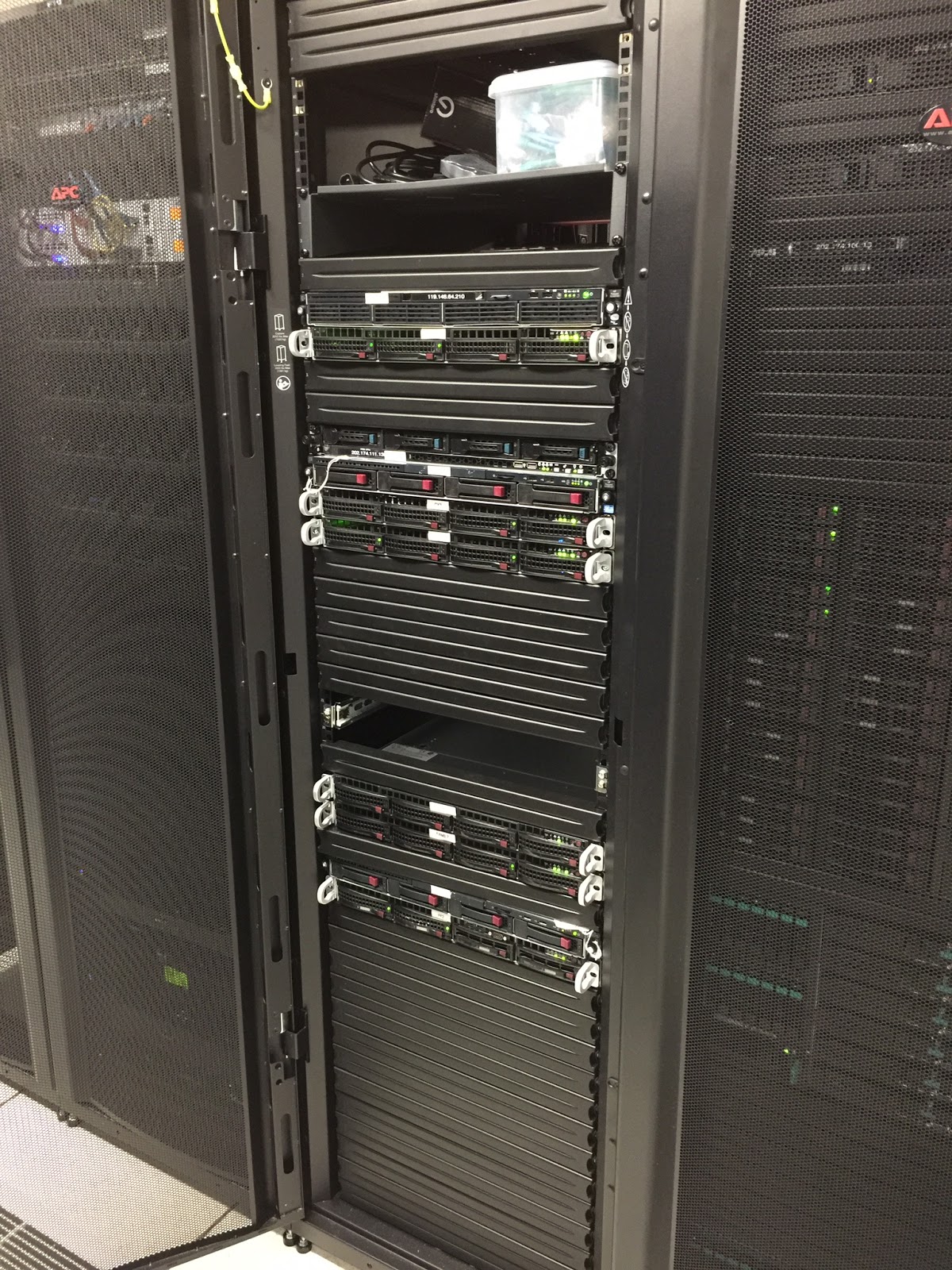
Some of our own dedicated servers

This is giving rise to a new trend of migrating quite a lot of services away from the cloud and back into on-premise, private cloud, or co-located dedicated servers - creating hybrid service offerings that can take advantage of the best that cloud offers but keeping others away from the cloud and remaining more economical for doing so.

As an exercise, we recently priced up the computing power, storage and data traffic for just a single one of our dedicated servers to work out the equivalent cost of an Amazon AWS instance.

This was for a fairly basic dedicated server that we originally provisioned in 2011 (8 cores, 2.5TB storage, 16GB RAM). We priced it based on its past 30-day utilisation, running at about 20% average CPU. It's a fairly busy server, but nothing extraordinarily flat-chat and frankly it's getting a little old and slow compared to our newer resources.

Our dedicated server costs, for hardware (upgraded every 36 months), the rack space with power and 200GB of traffic came to just shy of $800.00 per month (including amortising the hardware costs over 3 years).

Amazon's equivalent was an i2.8xlarge EC2 instance which would cost $3,300.00 per month (as a reserved resource) or $6,900.00 per month as "On-Demand"


That's a massive difference between cloud and dedicated hardware and can prove unbelievably uneconomical if you're not managing the instances well and - as many businesses tend to do - forget to regularly check that you're getting good value for money along the way.

The news is better if you compare one of our newer servers that currently has only a handful of shared-tenancy clients sitting on it and isn't terribly busy by most measures. This dedicated server would cost close to the same for us as the busy one in the example above (in this case about $700.00 per month) because we have to amortise the hardware costs, but from AWS would only cost about $120.00 per month.

Our solution, obviously, is to put more customers on this server over time so it becomes more profitable.


What would Amazon EC2 cloud cost us for one fairly busy server per month (USD) ?  Yikes!

We're obviously a little different to most businesses because we provide hosting ourselves and therefore keep a close eye on our resources, maintenance costs, etc - and in most cases we share the hardware resources across several customers at a time by providing shared tenancy hosting (one server, many websites) ... so our monthly charge--out rate for a small business website hosting (100MB storage and up to 5GB of traffic per month) is only $10.00 (+GST).

But you could imagine if we were, for instance, a mid-tier accounting firm who had moved our busy email server into the cloud a couple of years ago because our IT consultant said it would be a good idea - before we then doubled in size. With a cloud provider like AWS or Azure, we could be paying the equivalent of a brand new server every 3 months over-and-above the cost of the service itself - and would never actually have a server we could call our own.

Give us a shout if you need hosting for any size of business and if you're a bit of a greenie, check out our environmentally-friendly "GreenServe" solution that offsets the power used to run and cool the server (try doing that with your giant data centres, Amazon!).


Monday, November 28, 2016

(almost) FREE MONEY - Queensland Small Business Digital Grants

The Queensland State Government have made available funding for small businesses who want to improve their digital presence or improving their business to become more competitive through the use of digital technologies.

The initiative is called the Small Business Digital Grants Program.

These are matching grants of up to $10,000.00 (plus GST where applicable), meaning that - if eligible - your business could receive up to $22K (including GST) worth of systems and services at a cost of only $11 grand.

Up to 20% of your own contribution can even be made as in-kind effort for your personal time in being trained to use new technologies.

According to the SBDGP web page, the digital technology or services must fall under one of five areas:
  1. Digital marketing & social media
  2. Digital content (web pages, mobile apps, media etc)
  3. Receiving payments or selling online
  4. Specialised digital technology or software (business specific)
  5. Digital planning and advice/training

Queensland Government Grants and Creative Intersection can help your business get "digital"


This means that if you have a small business with less than 20 employees, with an ABN, and are headquartered in Queensland you could get a leg-up from the government for something like:
  • A website for your business
  • A private mobile app or website for your workers to perform their jobs better (e.g. a timesheeting or safety checklist app)
  • An online store
  • Adding the ability for your existing clients to pay their bills online through your website
  • Setting up and maintaining a social media page/feed (Facebook, Instagram, Twitter, SnapChat, etc)
  • Training or consultancy for yourself or your staff to learn how to use technology better for your business
To help you take advantage of this initiative, we have come up with some excellent offers that fall well with in the budget to give you the best bang for your government buck!

The current funding round closes on 9th December 2016, so if you're interested in improving your business and paying a lot less than you usually would, give us a shout and also check out the SBDGP web page.


Monday, November 7, 2016

Can I Patent My App or Software Idea ?

This is a question that we have been asked a lot over the nearly 17 years that we have been creating software applications (apps, functional websites etc) for clients all over the place.

Intellectual Property, or "IP", can be a bit confusing and it may be a good idea for you to talk to a solicitor for more specific advice once you get down the track a bit further with your idea, but we're happy for you to benefit from our experience with patents and copyright law at any time so here's a little of what we know.

The answer is that, yes, sometimes you can actually seek a patent for your app idea - but not generally for the app software itself.

You see, apps are software which means that the lines of code that are written by software developers such as ourselves, are controlled by copyright rather than patents. Generally, if you hire us to do a job (create an application) we will assign the copyright to you so that you can freely alter it, or have others alter it in the future without worrying that we will try to claim ownership over that code.

If you have created a whole new way of doing things - or even if you have just come up with a unique way of doing some part of an existing process - then you may be able to apply for a patent for that process itself.

Patents, according to the definition that IP Australia provides are "legally enforceable right for a device, substance, method or process" and for your application to be successful, "your invention must be new, useful and inventive or innovative".

The key thing with patents - aside from making sure that you actually have something unique that someone else hasn't come up with before - is that they let you establish a "Priority Date". This is the date at which you have been formally acknowledged as having come up with an idea and is usually the date that your application was approved by IP Australia.

In Australia, there are 2 types of Patents that can be relevant to your software idea:

The Standard Patent ("Invention")

This is the traditional type of patent wherein a full "Examination" is performed by IP Australia to ascertain if your idea has been invented by someone else before yourself. This process is the more involved (and more expensive) of the two types of patents but gives you better protection and lasts up to 20 years.

If you are granted a patent, you own the exclusive commercial rights to your invention.

For a cheaper alternative to get started, you can apply for a "Provisional Application" which gives you a sort of hold for 12 months while you consider whether you want to go through the process of a full patent application process. If before that 12-month period expires you decide to apply for a full patent (and assuming that patent is granted) then your Priority Date is established as the date of your Provisional Application rather than at the time of the full application.

You can apply for standard patents internationally either by filing in each country, or by filing through the Patent Cooperation Treaty (PCT) which gives you access to 148 countries (including Australia, of course).

The Innovation Patent ("Innovation")

This is a newer style of patent application that was introduced a few years ago by IP Australia and can be ideal for software and other "fast" technology-based ideas.

The idea here is that it's not so much about "invention" but rather it's about "innovation".

So, if you have come up with a new way of performing an existing process - but have made it better in some innovative way - then you can apply for an Innovation Patent.

Innovation Patents aren't searched ("Examined") by IP Australia so the cost is far less ($180.00 at the time of writing) and they only last for 8 years.

Examination by IP Australia is optional and can be requested by yourself or someone else who wants to challenge your patent in the future. If, at that point, your patent passes examination and is certified then you have an enforceable patent.

Typically, the process takes about a month for the patent to be granted and it usually takes about 6 months for an examination to be completed (if requested).

The documentation needed for an Innovation Patent is relatively simple, providing you have the right knowledge and forms (IP Australia are sticklers for using the correct formatting and margins etc in their applications).

We have helped a number of our clients to prepare the documentation needed for both types of patent applications and have been granted an Innovation Patent on our own concept called "AssessPal".

In the case of our AssessPal concept. our claims are that we are applying 3-D technology in a particular and unique to an existing process of assessing motor vehicles for damage. There are 3 separate claims (Innovation Patents can have up to 5 claims per patent). Check out our patent here.

An example of an accompanying illustration for our own "AssessPal" Innovation Patent application
(Australian Innovation Patent #2016101591, granted on 8/9/16)


Give us a shout and grab a coffee if you'd like to discuss whether we can help create your new idea.


Tuesday, July 12, 2016

Pun alert: We have some skin in the game!

The start of the new Financial Year sees Creative Intersection taking an exciting new step and becoming an equal partner in the ApreSkin app.

When we originally developed the ApreSkin app, alongside our client Dr Brad Jones (via his corporate innovation vehicle of 3D Medical Software Pty Ltd), we felt that the concept had such a huge potential that we couldn't help ourselves from investing our considerable resources to produce the best possible product.

Wanting to improve their ability to bring innovative products to market, 3D Medical Software approached us with an equity deal that has seen us take a 50% stake in the ApreSkin product line.

We are very much looking forward to guiding the technical development of ApreSkin, and already have a new public version of the app in the pipeline.

The "old" ApreSkin iPad app has been renamed to "ApreSkin MD" as we added a cutting-edge graphics engine for even better compatibility and performance. The new public-use app will be known as "ApreSkin you" and will initially be release for iPhone (with an Android version in the pipeline). 

Watch this space for its release in the next few weeks.


ApreSkin - Creative Intersection's exciting new direction with a 50% stake in this app

Thursday, April 28, 2016

Apple Pay with ANZ (including VISA) in Australia today

This is an update from our previous post back in November 2015 where we announced that Apple Pay had hit Australia in a limited way. At the time, the service was limited to American Express cards issued by Amex themselves only.

Well, that all changed today after ANZ and Apple finally reached an agreement over fees that Apple charge to provide the gateway between their devices and the merchant/clearance facilities that the banks provide.

The "interchange fees" that the card-issuing bank can charge the acquiring bank (the bank handling merchant services for a business) are capped at 0.5% in Australia, so there's only a fairly small pie for those card-issuing banks to share with Apple.

It all comes down to tenths of a percent, but all that adds up to big bickies when you have - potentially - billions of dollars in transactions processed every week.

So, as of today, you can use Apple Pay if you have an iPhone of the correct flavour (iPhone 6/6 Plus or newer, any Apple Watch, or iPad 2/Pro/Mini3) and an ANZ card (Visa or Amex ... but not Mastercard, ANZ Access or ANZ Corporate cards).

Looking at ANZ's info page (http://applepay.anz.com/), they have a delightful little slam of their opposition in the Terms and Conditions (point #2:  "Apple Pay is not currently available at NAB, CommBank or Westpac"). Gotta love the bravado, but hope they remember to change that bit in a couple of months when the other banks finalise their own negotiations!

Remember that not only does Apple Pay mean easy payments for consumers at the checkout, but Apple Pay can be integrated into apps to pay for real-world goods and services without the 30% cut that Apple take for in-app purchases. Uber already has an option to pay for rides using your credit card using Apple Pay in some regions.

If you have an app idea or an existing app that could benefit from Apple Pay integration, give us a shout.


Confirmation of ANZ Visa card added to Apple Watch Wallet


Ready to start spending money using ANZ Visa via Apple Watch

Tuesday, February 2, 2016

Announcing our Parse Migration and Hosting Service

As of January 2017, the party is over and Parse will stop operating. Hundreds of thousands of apps that rely on services provided by Parse will stop working entirely and developers need to get their apps converted to other platforms or providers before this date to avoid being rendered inoperable.

Facebook have, however, been kind enough to create a number of tools to help migrate data from their Parse platform - and more importantly have open-sourced the server itself (without a few of the features).

The team at Creative Intersection, being app development experts across a large number of platforms, have started to offer our help to owners of soon-to-be-orphaned apps to migrate to open-source versions of Parse Server hosted by us ... or to migrate the services baked into those apps across to bespoke solutions (like those that we create and use every day for apps that we develop). Such bespoke solutions are not dependent on any one vendor and therefore are portable between hosting providers and support teams.

Check out our Parse Migration and Hosting page for details.

If you are one of the unfortunate app publishers or developers left out in the cold by the Parse shut-down, drop us a line and we can talk about what is needed to help you keep your app alive.


Parse is shutting down.


Sunday, January 31, 2016

The Dangers of using Third-Party App Backend Services

We often meet with would-be and current app publishers to discuss taking over their partly-finished apps from overseas and local developers when the wheels have started to come off the cart. It is a sad fact of life, but you tend to get what pay for and choosing shortcuts and cheap outsourced options often brings with it some fairly predictable outcomes.

We don't judge, and are (almost) always happy to lend a helping hand to finish apps to a Release stage if they have failed to be completed.

Unfortunately, however, we also come across situations where an inappropriate platform has been chosen and that platform simply won't get the app the rest of the way to a completed, scalable product.

Sometimes it's because previous developers have chosen to create a "cross-platform" app using any number of tools that are yet to work and perform perfectly on any platform.

But the more heart-breaking scenario is when previous developers have deliberately chosen the latest and greatest service platform that then gets shut down because it was just isn't making money (or start charging huge sums of money for existing apps to remain active).

One platform that we have talked with a few app publishers about in the past is called "Parse", a "Mobile Backend as a Service" (or MBaas) product. On the surface of it, it seemed like a good idea to them - owned by Facebook since 2013, it enjoyed a good following and made it easy for less technically athletic developers to create complex services such as Push Notifications and server-side data storage/API's.

Mark Zuckerberg presents at the Facebook Parse Developer Day in 2013.
Pic courtesy of Jolie O'Dell/VentureBeat


Our Managing Director, Ian Exaudi, recalls having meetings with several prospective and current app publishers as recently as last year, who were keen to save budget by getting their app to work via Parse instead of a bespoke API such as those that Creative Intersection builds and hosts.

"It's a tragedy when an app publisher spends $50-80K on an app through another developer only to discover that the app will soon stop working and need to be completely re-built because someone has decided to kill off a third-party service", says Ian. "We feel the pain of these entrepreneurs who are having a red-hot go at doing something cool with a new app but have gotten themselves stuck after receiving ill-considered or inexperienced advice early in their venture".

Last week's announcement from Facebook is a case-in-point. Parse will be shutting down in January 2017, leaving many app developers and publishers stuck and needing to invest in massive changes to their apps and systems just to keep going.

Here is Parse's own announcement.

Lesson:  Own as much of your product as you can!

If you would like to talk about how to get your Parse-based app working again, give us a shout.

(update 3/2/16): We are now offering a Parse Data Migration and Hosting service.


Wednesday, January 6, 2016

In-depth Analysis Competition Winner Drawn

Congratulations to Jennifer Barraclough from Tassie who was drawn at random from the 574 entries we received across Facebook and Twitter during our competition.

We have been in touch with Jennifer and are excited to see how her great app idea will change the world!


Sunday, December 27, 2015

Infinitely scalable Google Play badge

Time to give a little something back to the community in the form of a Google Play badge that is infinitely scalable (in other words, it is a vector version).

Even though Google is one of the most recognised brands on the planet they are actually pretty terrible at managing their branding and disseminating the necessary files to the developer community to use for consistent branding (at least compared to the likes of Apple) ... and so as we were creating the artwork for a pull-up print banner (850mm x 2000mm in size) and needed a resizable "Get it on Google Play" badge that could scale up to half the width of the banner, it was nowhere to be had.

Sure, Google Play have a developer resource page that lets you create the various badges, but they only ever output as PNG files that look absolutely terrible at large size.

We had the same problem a few years ago when creating signage for our old office that needed a huge Google logo (we were doing SEO at the time).

So, we created a scalable version of the "Get it on Google Play" badge by pulling together a number of different resources. Any developers or publishers needing to create large artwork (for print, usually), feel free to take it and use it as you wish. We claim no copyright over it, but would love a hat tip via Facebook, Twitter, or an email if you find it useful.

Need a scalable version of the "Get it on Google Play" badge?

Wednesday, December 16, 2015

Android Pay coming to Australia in 2016

On the back of the recent launch of the Apple Pay service in Australia (tied to American Express cards only), Google have announced that they have signed up ANZ, Westpac, IGNG Direct, Bendigo Bank, Bank SA, and a number of major Aussie retailers to their Android Pay service and will be launching it in Australia sometime in the first half of 2016.

The feature-set of the Android Pay service is almost identical to the Apple Pay service, in that it works with contactless payment systems already in place at many retail locations in the form of "PayPass" and other branded services ... as well as offering app developers the ability to integrate the service into their apps for fast in-app payment for real-world items such as T-shirts, hotel bookings, etc.

Android Pay will be able to store your Mastercard and Visa credit (and debit) cards. No word on whether bank-based American Express cards (or direct Amex cards) will work.

This is all good news for app publishers because it further cements the use of the mobile phone as a method of payment and thereby provides even more opportunities to make a grab for customers' wallets at points in time that are convenient to them.


Android Pay is hitting stores in Australia in the first half of 2016 (pic courtesy of Google/Android Pay)

If you have an app idea or would like to know more about what we do, give us a shout.


Friday, December 4, 2015

Got an App Idea? Win a Free In-depth Analysis

This month we are trying something new at Creative Intersection ... A competition!

We usually provide a free meeting to come and discuss an app idea with our experts at our Milton office, and then our clients either engage us to flesh out that idea or do some more homework themselves before we can properly quote on the costs and time needed to make the idea come to life.

This month, however, we are going to try something a little different:

For every Like on Facebook or Retweet on Twitter, we'll enter you into a draw to win a 10-hour scoping project worth just under $2,000.00!

This is an awesome chance to find out if your cool idea is worth pursuing. Get in front of our app experts and get the benefit of their years of experience in designing and developing mobile and web applications.


Get Social and Win ... Like or Retweet to win a Free In-depth Analysis "Scoping" Project


The Prize:


We have a chat over a cup of coffee (or your favourite beverage), after putting in place our normal Non-Disclosure Agreement (NDA), so your idea is protected.

We meet with you for a couple of hours, getting a good understanding of what your concept entails and giving you some immediate feedback and thoughts as we go.

We then work through the technical and market potential of your idea to see if it has legs, and provide you with a report outlining our findings and an initial scoping document that you can take to other developers for costing (and of course we will provide a quote too).


How to give yourself the best chance to win:


Facebook ... Like our Creative Intersection Facebook page for a chance to win
Facebook ...  Like our competition post for another chance to win

Twitter ... Retweet the link to this blog post and mention us (@C_Intersection) for a chance to win

Best of all, the scoping project prize is transferable ... so if you have an idea just get your mates or followers to Like or Retweet ... and if your friends win the prize but don't have their own cool app idea to get off their chest then they can give the prize to you.

So, if you - or a friend - have an idea and you'd like to flesh out and see if it's a go-er, do your thing!


When will we draw this cool prize?


We will draw the prize on 1st January 2016 and will announce it via Twitter, Facebook, and this blog.

Update 1/1/16:  We have had such a great response that we have decided to extend the competition until 11:59pm on Sunday 3rd January 2016. Enter before then and we will include you in the draw.

Note:  Unfortunately this competition is for Aussie residents only so although anyone can enter if you are not in Australia then if you win you will have to give your prize to someone who is an Australian resident.


Visit our website for more information about who we are and what we do.


Wednesday, November 11, 2015

Apple Pay coming to Australia VERY soon (actually today)

With American Express recently emailing all Australian customers to let them know that Apple Pay is being launched in Australia soon, we thought it an opportune time to explain a bit about what this is and what it means to the average consumer.

Apple CEO, Tim Cook, also confirmed the launch of Apple Pay in Australia and Canada in an investor call a couple of weeks ago, and our own inquiries confirm that Amex and Apple are indeed planning to launch the Apple Pay service very soon in a shared launch.

What is Apple Pay?


Apple Pay is a service that allows the encoding of credit card information inside a device (like a mobile phone) in such a way that it can be safely transmitted when requested by another device (like a credit card terminal).

If you have ever used "Visa payWave" or a similar payment method by touching your credit card on a terminal in a shop (as opposed to swiping or inserting it into the machine), then you have already used the technology that underpins the financial transaction side of Apple Pay.

In the above case, the card contains an "NFC" (or Near Field Communication) chip that activates when it receives a magnetic jolt from the terminal. Incidentally, that magnetic jolt is why your credit card doesn't need to have a battery attached - it provides the power for the chip.

From a technical perspective, the point-of-sale service works a little like a secret knock. Think of the payment terminal tapping out the first part of "Shave and a Hair Cut", to which your NFC-enabled card or device responds with "Two Bits". Add a bunch of technical complexity of talking between different computers around the world in the blink of an eye and you have a credit card system that can safely authenticate that a card is a real card because it knows the secret knock when asked. ... and of course ignore the fact that everyone knows this particular sequence so it's hardly a secret knock.

Now, if we take the NFC chip that's embedded into a single credit card and we put it into a phone (or even a watch) and make it programmable so it can contain more than one credit card's worth of information and you have a system that can learn and contain all of a user's credit cards without having to re-issue a new device with every card ... and that's the beauty of the NFC phone payment revolution.

To add further security, we then make the user confirm their identity to ensure that their phone hasn't just been stolen. The simplest way of doing that is by a fingerprint scan, which Apple's compatible devices can already use as a key to unlock data within its encryption store.

Apple didn't invent this, and in fact many Android devices been able to do this for years ... however when three 500-pound gorillas get involved we all tend to want to sit up and pay attention.

American Express / Apple Pay, Coming Soon (image courtesy of American Express)

Gorillas ?  What The ??


So, if two of the 500-pound gorillas are American Express and Apple, who is the third ?

If you wanted to launch a new payment service in Australia, you would want a major retailer on board if for no other reason than it provides great B-roll for a news story. There really are only two retailers with a large-enough footprint in Australia to matter .... so which of Coles or Woolies is our third gorilla then ?

The answer is simple ... look at the back of your American Express card. If it has a symbol that looks like a sideways WiFi icon,  take it to both stores and grab some groceries. Which one lets you wave your card past the terminal for payment ?  We did exactly that and ... Bingo! Woolies is our third gorilla.

Granted, the existence of the third gorilla in this equation is speculation on our part, so let's all watch the nightly news and breakfast shows in a week or two when the official launch happens.

Which Apple Devices Can I Use ?


The Apple devices that incorporate NFC chips currently are: iPhone 6/6s, iPhone 6/6s Plus, and Apple Watch.

Oooooh - So I'll Be Able to Use My Apple Watch to Pay at the Supermarket ?


Yep!  And you'll look very cool doing it. Remember to wear your "I Love Apple" t-shirt as many selfies will be requested.


What's Next ?


The next exciting thing will hopefully be for developers (such as ourselves) to gain access to the NFC chips on Apple devices and program them to respond to proprietary NFC systems, such as keyless entry to cars and other doors.


UPDATE 19-Nov-2015 .... 

Apple Pay and Amex have officially launched in Australia today.

As of this morning, however, only the Apple Watch app is allowing the adding of a card to that device. The iPhone/iPad Wallet apps have not yet been activated. This is a fairly common strategy of releasing a system/feature to only a subset of users for a few hours to check load capacities and any real-world bugs that might come up ... so we expect that iPhone 6/6Plus/6s/6sPlus devices will be activated later today.

... and who is the third 500-pound gorilla ?  Actually it turns out Amex and Apple have done quite a bit of negotiation behind the scenes because the following major Aussie retailers are already able to accept Apple Pay payments as of this morning:  David Jones, McDonalds, Kmart, Bunnings, Coles and Woolworth. Some checkouts in some stores may be unable to accept the contact-less method of payment but for the most part this is working fine as of this morning.

Here's what the screen looks like on your Apple Watch when paying via Apple Pay


Media inquiries


Tuesday, October 13, 2015

Apple App Store Price Rises for Australia October 2015

Along with the rest of the developer community, we have been notified this morning of price rises happening to apps and subscriptions in the Australian Apple App Store (as well as Indonesia and Sweden).

These price rises take effect in the next 36 hours and are due to exchange rates and actually offer a good opportunity for Australian developers to earn higher royalties than before, particularly if their main income base is in Australia (the current exchange rate takes care of the rest of the world for us).

For example, Australian Developers will now receive $0.95 for a Tier 1 app which is charged at $1.49 (Aussie Dollars). The below table shows this (remember, Aussie devs pay GST so Apple's actual commission is still 30% but the remainder - the developer's royalty - then has GST taken out before Apple transfers to our banks in Australia).

Updated Apple App Store Pricing for Australia, commencing Mid October 2015