
P: 1300 853 868 / 07 3056 0665
Mobile/Tablet Apps | Websites | Applications
Showing posts with label Australian Made and Owned. Show all posts

Monday, December 5, 2016

Are you running away from the cloud too ?

The last handful of years has seen an en-masse migration away from dedicated servers for businesses and government into virtual servers (sometimes called Virtual Machines, or VMs) that are generally hosted within large data centres.

Providers such as Amazon Web Services (AWS) or Microsoft Azure are well known to many of us as "cloud providers" that can help take the worry out of hardware purchasing and maintenance by providing a slice of a machine's computing power and storage instead of the entire thing.

The size of the slice can change with your needs, and so a scalable solution can be found for many things.

In this way, "cloud" providers were seen as generally being able to provide a more cost-effective way of hosting your online services (public or private) and could increase the computing power very quickly if the need arose.

That's a great theory ... but you know what they say about theory and practice ... "In theory, there is no difference between theory and practice - but in practice, there is".

The reality of cloud providers is that they are there to make money like any business - and so even though they have a very wide scope to spread the cost of their hardware across many customers per physical server (or the equivalent thereof, depending on how they have built their cloud), they will always tend towards a less-than-fair model for pricing because the whole question of server resources is rather opaque to most users.

So whilst the trend for the past few years has been to migrate to the cloud, there is an increasing trend in the last 6 months or so for some business bean counters to have done what they do best (counted their beans) and worked out that - in actual fact - they are worse off economically for being in the cloud than before when they had some of their dedicated servers located within their own premises or co-located within data centres.
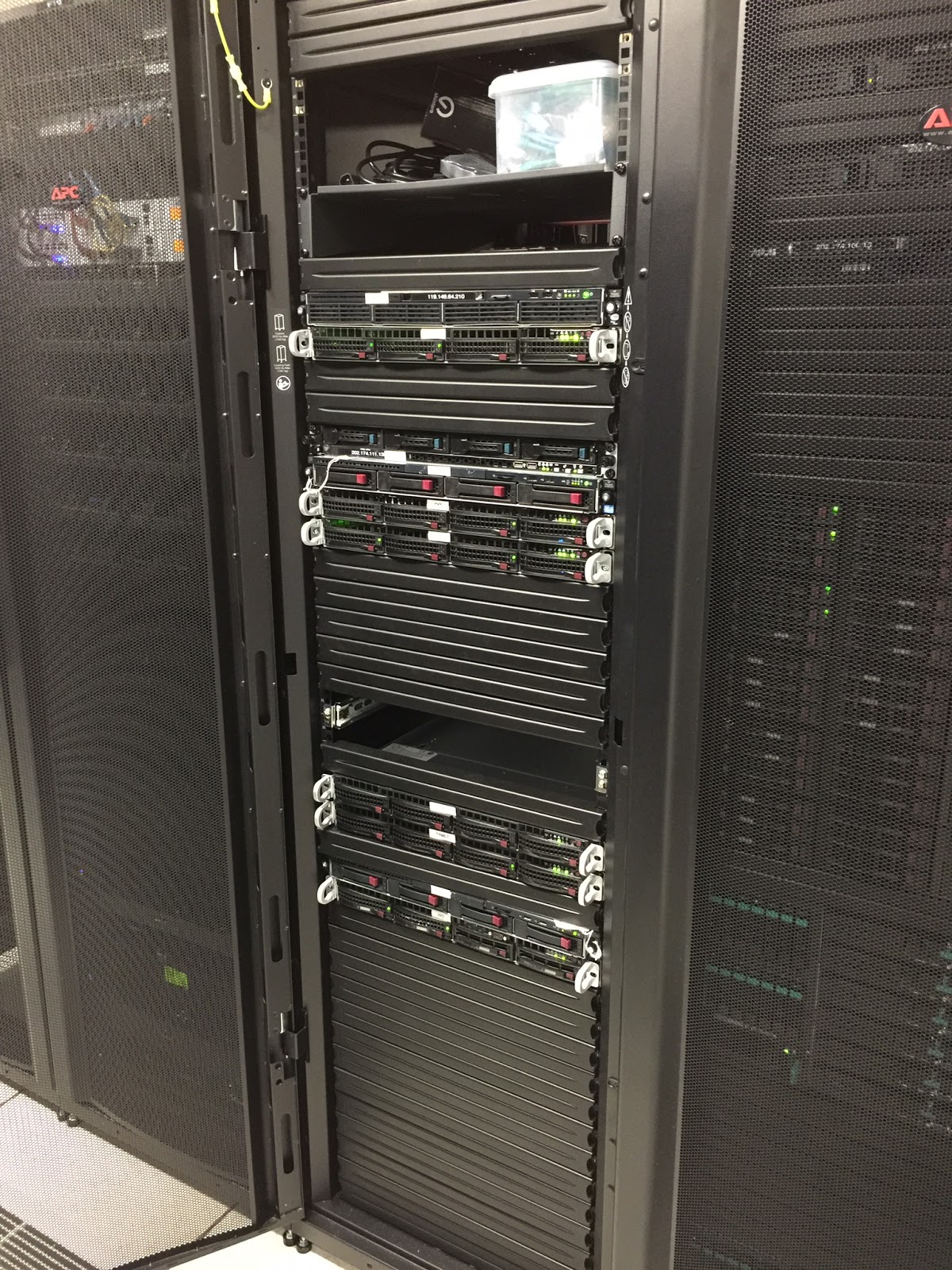
Some of our own dedicated servers

This is giving rise to a new trend of migrating quite a lot of services away from the cloud and back into on-premise, private cloud, or co-located dedicated servers - creating hybrid service offerings that can take advantage of the best that cloud offers but keeping others away from the cloud and remaining more economical for doing so.

As an exercise, we recently priced up the computing power, storage and data traffic for just a single one of our dedicated servers to work out the equivalent cost of an Amazon AWS instance.

This was for a fairly basic dedicated server that we originally provisioned in 2011 (8 cores, 2.5TB storage, 16GB RAM). We priced it based on its past 30-day utilisation, running at about 20% average CPU. It's a fairly busy server, but nothing extraordinarily flat-chat and frankly it's getting a little old and slow compared to our newer resources.

Our dedicated server costs, for hardware (upgraded every 36 months), the rack space with power and 200GB of traffic came to just shy of $800.00 per month (including amortising the hardware costs over 3 years).

Amazon's equivalent was an i2.8xlarge EC2 instance which would cost $3,300.00 per month (as a reserved resource) or $6,900.00 per month as "On-Demand"


That's a massive difference between cloud and dedicated hardware and can prove unbelievably uneconomical if you're not managing the instances well and - as many businesses tend to do - forget to regularly check that you're getting good value for money along the way.

The news is better if you compare one of our newer servers that currently has only a handful of shared-tenancy clients sitting on it and isn't terribly busy by most measures. This dedicated server would cost close to the same for us as the busy one in the example above (in this case about $700.00 per month) because we have to amortise the hardware costs, but from AWS would only cost about $120.00 per month.

Our solution, obviously, is to put more customers on this server over time so it becomes more profitable.


What would Amazon EC2 cloud cost us for one fairly busy server per month (USD) ?  Yikes!

We're obviously a little different to most businesses because we provide hosting ourselves and therefore keep a close eye on our resources, maintenance costs, etc - and in most cases we share the hardware resources across several customers at a time by providing shared tenancy hosting (one server, many websites) ... so our monthly charge--out rate for a small business website hosting (100MB storage and up to 5GB of traffic per month) is only $10.00 (+GST).

But you could imagine if we were, for instance, a mid-tier accounting firm who had moved our busy email server into the cloud a couple of years ago because our IT consultant said it would be a good idea - before we then doubled in size. With a cloud provider like AWS or Azure, we could be paying the equivalent of a brand new server every 3 months over-and-above the cost of the service itself - and would never actually have a server we could call our own.

Give us a shout if you need hosting for any size of business and if you're a bit of a greenie, check out our environmentally-friendly "GreenServe" solution that offsets the power used to run and cool the server (try doing that with your giant data centres, Amazon!).


Monday, November 7, 2016

Can I Patent My App or Software Idea ?

This is a question that we have been asked a lot over the nearly 17 years that we have been creating software applications (apps, functional websites etc) for clients all over the place.

Intellectual Property, or "IP", can be a bit confusing and it may be a good idea for you to talk to a solicitor for more specific advice once you get down the track a bit further with your idea, but we're happy for you to benefit from our experience with patents and copyright law at any time so here's a little of what we know.

The answer is that, yes, sometimes you can actually seek a patent for your app idea - but not generally for the app software itself.

You see, apps are software which means that the lines of code that are written by software developers such as ourselves, are controlled by copyright rather than patents. Generally, if you hire us to do a job (create an application) we will assign the copyright to you so that you can freely alter it, or have others alter it in the future without worrying that we will try to claim ownership over that code.

If you have created a whole new way of doing things - or even if you have just come up with a unique way of doing some part of an existing process - then you may be able to apply for a patent for that process itself.

Patents, according to the definition that IP Australia provides are "legally enforceable right for a device, substance, method or process" and for your application to be successful, "your invention must be new, useful and inventive or innovative".

The key thing with patents - aside from making sure that you actually have something unique that someone else hasn't come up with before - is that they let you establish a "Priority Date". This is the date at which you have been formally acknowledged as having come up with an idea and is usually the date that your application was approved by IP Australia.

In Australia, there are 2 types of Patents that can be relevant to your software idea:

The Standard Patent ("Invention")

This is the traditional type of patent wherein a full "Examination" is performed by IP Australia to ascertain if your idea has been invented by someone else before yourself. This process is the more involved (and more expensive) of the two types of patents but gives you better protection and lasts up to 20 years.

If you are granted a patent, you own the exclusive commercial rights to your invention.

For a cheaper alternative to get started, you can apply for a "Provisional Application" which gives you a sort of hold for 12 months while you consider whether you want to go through the process of a full patent application process. If before that 12-month period expires you decide to apply for a full patent (and assuming that patent is granted) then your Priority Date is established as the date of your Provisional Application rather than at the time of the full application.

You can apply for standard patents internationally either by filing in each country, or by filing through the Patent Cooperation Treaty (PCT) which gives you access to 148 countries (including Australia, of course).

The Innovation Patent ("Innovation")

This is a newer style of patent application that was introduced a few years ago by IP Australia and can be ideal for software and other "fast" technology-based ideas.

The idea here is that it's not so much about "invention" but rather it's about "innovation".

So, if you have come up with a new way of performing an existing process - but have made it better in some innovative way - then you can apply for an Innovation Patent.

Innovation Patents aren't searched ("Examined") by IP Australia so the cost is far less ($180.00 at the time of writing) and they only last for 8 years.

Examination by IP Australia is optional and can be requested by yourself or someone else who wants to challenge your patent in the future. If, at that point, your patent passes examination and is certified then you have an enforceable patent.

Typically, the process takes about a month for the patent to be granted and it usually takes about 6 months for an examination to be completed (if requested).

The documentation needed for an Innovation Patent is relatively simple, providing you have the right knowledge and forms (IP Australia are sticklers for using the correct formatting and margins etc in their applications).

We have helped a number of our clients to prepare the documentation needed for both types of patent applications and have been granted an Innovation Patent on our own concept called "AssessPal".

In the case of our AssessPal concept. our claims are that we are applying 3-D technology in a particular and unique to an existing process of assessing motor vehicles for damage. There are 3 separate claims (Innovation Patents can have up to 5 claims per patent). Check out our patent here.

An example of an accompanying illustration for our own "AssessPal" Innovation Patent application
(Australian Innovation Patent #2016101591, granted on 8/9/16)


Give us a shout and grab a coffee if you'd like to discuss whether we can help create your new idea.


Monday, October 12, 2015

We are Australian Made and Owned

We are extremely happy to announce that our home-grown Content Management System (CMS), ciSUITE:, has been approved to carry the prestigious Australian Made and Owned logo.

Our development team has worked on this product (and many others) over the years from our office in Brisbane, and ciSUITE: has powered a huge number of websites since 2003 when it was in its infancy.

ciSUITE: by Creative Intersection is Australian Made and Owned
ciSUITE: by Creative Intersection ... Australian Made and Owned
Unlike many open-source CMS platforms (such as Joomla!, Drupal, and WordPress), ciSUITE: is inherently safer because we protect our source code from the prying eyes of nasty hackers. In fact, we are often asked to migrate open-source CMS sites that keep being constantly hacked into our more secure ciSUITE: platform.

Whilst ciSUITE: is currently the only one of our products formally licensed to carry the Australian Made and Owned logo, all of our other services such as Mobile App Development and ongoing support are also performed by our own in-house designers, developers, analysts, and testers - all of whom are onshore. We don't offshore work. Ever.