Apple have announced some pricing changes that will affect a small number of local "stores", including the Australian iTunes App Store.
No news yet on what the changes will be specifically, but it looks like there will be an adjustment to some of the pricing "tiers" that Apple app publishers have to choose from to set the price of their apps.
In Apple's iTunes App Store, a publisher can't choose just any price for their app ... they have to choose a tier which then relates to a price in each country in which the app is sold.
The "free" tier is obviously the same worldwide, whereas Tier 1 - for example - equates to USD 0.99. Australian apps at Tier 1 prices were previously AUD1.19 but were brought back into line with USD a couple of years ago due to exchange rates.
Apple are now adjusting that again, which means that the prices for Australian apps will most likely go up slightly.
The good news ? ... If you're an app developer/publisher who resides in Australia then your app prices will increase for any apps sold in Australia, and your 70% cut of that app price will increase accordingly.
Don't forget - if you're thinking of creating an app, check out our blog post on how to best monetise your app (hint: don't charge up-front ... charge for in-app purchases or use advertising).
Update 2-Apr-2014: Apple's new Australian pricing changes the Tier 1 app price from $0.99 to $1.29 (AUD) and Tier 2 from $1.99 to $2.49 (AUD). This is a sharp rise (25-30%) which seems a little out-of-line with the AUD exchange rate but the positive side is that as an app publisher you now earn 25-30% more for those lower Tiers.
The other Tiers have also changed to varying degrees (remember there are many Tiers right up to Tier 87 which is now a whopping $1,299.99 AUD).

P: 1300 853 868 / 07 3056 0665
Mobile/Tablet Apps | Websites | Applications
Tuesday, April 1, 2014
Friday, February 7, 2014
New 3D Printing and Prototyping Service for Brisbane
We're excited and happy to announce that Creative Intersection has started offering a 3D Printing and Prototyping service to businesses, professionals and students in Brisbane and Southeast Queensland.
Our 3D printer has an accuracy of 200 microns (0.2mm) and uses ABS or PLA plastic to build up complex 3D models as large as 140mm cubed.
This service is perfect for:
There are free apps available to take a series of pictures and effectively scan yourself (or a special friend) and create a 3D model of that person.
You can even download free files from places like Thingiverse, 123d (Autodesk), Cubehero, Youmagine, and others and then just send them to us for manufacturing.
Click here for more details about this exciting new 3D printing service.
Our 3D printer has an accuracy of 200 microns (0.2mm) and uses ABS or PLA plastic to build up complex 3D models as large as 140mm cubed.
 |
| Example of 3-part model of the Google Android logo, printed and then assembled |
This service is perfect for:
- Engineers and engineering students
- Inventors
- Hobbyists
- Lovers of custom novelty "stuff"
- Anyone looking to create a special one-off gift for someone
- Tinkerers who need that little doo-dad for the thingamabob that just broke
- Bakers (domestic and commercial) making custom cookie-cutters (there's even a Mac and PC program for that)
 |
| Some printed models, including our logo and a bust of one of our designers! |
There are free apps available to take a series of pictures and effectively scan yourself (or a special friend) and create a 3D model of that person.
You can even download free files from places like Thingiverse, 123d (Autodesk), Cubehero, Youmagine, and others and then just send them to us for manufacturing.
Click here for more details about this exciting new 3D printing service.

Tuesday, January 7, 2014
In-App Purchases By Far Exceed Paid Apps
News just in last week from our friends at eMarketer: Free apps with in-app purchases account for nearly all non-advertising revenues.

In other words ... if your app is available only as a paid version you are most likely missing out on a very large proportion of the revenue that you could otherwise be earning.
We have known this for years, based on anecdotal evidence from our numerous clients - which is why our recommendation is often to release a free limited version which allows for the user to experience the main features of your app without risking being sold a lemon (after all, there are a lot of try-hard and me-too apps on the App Store - both Apple/iOS and Google/Android).
Interestingly, while the Google Play Store (Android apps) has been picking up quite a bit of market share, it's almost exclusively (98%) for apps that are free to download and which then offer in-app purchases. Apple users aren't far behind with 92% of revenue from the Apple App Store being from free apps with in-app purchases. For Apple, that's a 15% increase in 11 months and is creeping ever-closer to 100% for either platform.
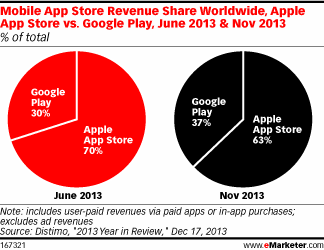
The lesson here is to remember to think about how you're best going to earn back the development costs and like any business, it pays to understand your customers' spending habits.
If you have a great idea for an app for iPhone, iPad, or Android handsets and tablets and would like to discuss it with us confidentially to see if it can be done (and how best to position yourself to make a profit from it), give us a shout.
Wednesday, October 31, 2012
iMessage services down due to Hurricane Sandy
We have seen several reports of that the iMessage service provided by Apple is having some problems and messages in many cases are failing to deliver between i-devices.
This also seems to affect other APN (Apple Push Notification) services such as those provided in many apps available on the iTunes App Store.
The current prevailing theory is that message traffic generated in the wake of Hurricane Sandy may have caused Apple to need to add capacity to their APN systems, which has left many "tokens" unable to be used (a "token" is a unique identifier stored in your phone to help it let Apple's servers know who you are and what services you should be receiving).
Another theory is that Apple's North Carolina data centre is being slammed and has had to drop some services. Those services are being re-routed to other data centres.
Right now, the best fix seems to be to simply restart your iPhone or iPad (if it is having trouble successfully sending a message).
If you are in the affected areas, you may also experience data outages (e.g. your own ADSL and WiFi), in which case iMessages and other notification services may not work anyway. In such cases, disconnect your iPhone/iPad from the WiFi network (if ADSL/cable internet is down) and try using your carrier's 3G network instead.
Our best wishes go out to our friends and customers on the East Coast of the U.S..
Saturday, October 6, 2012
Creative Intersection Announces Passbook Pass Service
In keeping with our tradition of staying at the forefront of technology, and providing reasonably-priced solutions for all businesses wanting to improve their customer engagement and retention - we're proud to announce that we have started providing customised Apple Passbook Passes to Australian (and international) businesses of all sizes.
Passbook Passes are clever little things that can be easily saved to an iPhone user's device to provide paperless replacements for vouchers, membership cards, boarding passes, tickets, and other barcoded materials.
The passes can even be time and location-aware. For example, if your shop offers a discount on a certain day, your customer's phone can let them know when they're in the neighbourhood at that time ... to remind them to drop in for their special offer.
Passes can even be connected to servers and apps to allow for live updating and personalisation (how many more coffees before you can claim your free 10th coffee ?).
Check out our website for a little more information about Apple Passbook Passes for Australian businesses and to download our (free) example pass.
 |
| Apple Passbook Passes - Customer Loyalty Improved! (original photo: courtesy Techcrunch) |
Friday, September 21, 2012
The Woz is Back in Town
Regular visitors to our blog may remember that we spent a couple of hours chatting with Steve "Woz" Wozniak - co-founder of Apple Inc - a little while back as a guest at one of our Peer Presentations.
Since then, honourary CI Staffer and winner of the inaugural "Creative Intersection Certificate of Awesomeness", Steve Wozniak has taken a shine to Australia - and Queensland in particular.
This visit sees him in town for a QUT Business Leaders Forum, but of course not one to pass up a good line-waiting, Woz was near the front of the line at Apple's Chermside store to get his hands on the iPhone 5.
Good onya Woz ... nice to have you back ... and great to see that your jetlag finally worked in your favour :-)
 |
| The Waiting Woz ... Picture courtesy of TechCrunch |
Sunday, September 9, 2012
QR Codes Already Look Old-Hat
So, you've heard about QR Codes ? ... You know - those cool little squares of dots that you can scan with your mobile phone to find out more about the poster at your local bus stop.
They work by encoding a piece of information (usually a URL or phone number) into a picture that can be recognised by an app and decoded for use by the end-user.
QR Codes are neat and are finally starting to get a bit more traction in Australia, having been massively popular particularly in Asia for a couple of years.
Now there's a new player emerging and it promises to let you interact in an even more personal way with "real world" objects.
Most tablet and smartphone devices (Android, Windows Mobile, Apple iOS etc) use a technology known as "capacitive touchscreens". This works - basically - because the human body is slightly electrically conductive, allowing the device to detect changes in the electrostatic field of the screen when it is touched by your fingers or a special stylus (Wikipedia explains it much better).
You can even buy gloves that let you use your smartphone in cold climates by conducting electricity from the tips of the outside of the glove through to your fingertip.
So, if electrical conductivity of the human body can be used to control your phone, why couldn't a piece of similarly conductive material be used to do the same thing ?
In fact, it can. Just print a pattern on the paper (a playing card or a magazine, for example) using a special capacitive ink and the pattern - when pressed against a touchscreen - will register as if a very complex hand was touching the screen.
Then all you need is to have clever app developers like Creative Intersection build an app that can read those patterns and translate them into actions within the app.
As a long-time member of the Printing Industries Association of Australia, we are already in talks with local printers to provide this technology under license from its German inventors.
If you too can see some potential for this technology (or the Good Ol' QR Code), combined with an app for iPhone/iPad, Android phone or tablet, or Windows mobiles & tablets, call us for a chat.
They work by encoding a piece of information (usually a URL or phone number) into a picture that can be recognised by an app and decoded for use by the end-user.
 |
| Example of a generated QR Code which generates an SMS message on the user's phone (courtesy: kaywa.com) |
QR Codes are neat and are finally starting to get a bit more traction in Australia, having been massively popular particularly in Asia for a couple of years.
The Next Generation of Interaction
Now there's a new player emerging and it promises to let you interact in an even more personal way with "real world" objects.
Most tablet and smartphone devices (Android, Windows Mobile, Apple iOS etc) use a technology known as "capacitive touchscreens". This works - basically - because the human body is slightly electrically conductive, allowing the device to detect changes in the electrostatic field of the screen when it is touched by your fingers or a special stylus (Wikipedia explains it much better).
You can even buy gloves that let you use your smartphone in cold climates by conducting electricity from the tips of the outside of the glove through to your fingertip.
So, if electrical conductivity of the human body can be used to control your phone, why couldn't a piece of similarly conductive material be used to do the same thing ?
In fact, it can. Just print a pattern on the paper (a playing card or a magazine, for example) using a special capacitive ink and the pattern - when pressed against a touchscreen - will register as if a very complex hand was touching the screen.
Then all you need is to have clever app developers like Creative Intersection build an app that can read those patterns and translate them into actions within the app.
 |
| Example of Touchcode (courtesy: nukotoys.com) |
As a long-time member of the Printing Industries Association of Australia, we are already in talks with local printers to provide this technology under license from its German inventors.
If you too can see some potential for this technology (or the Good Ol' QR Code), combined with an app for iPhone/iPad, Android phone or tablet, or Windows mobiles & tablets, call us for a chat.